

Library Catalogue
| Item type | Current library | Shelving location | Call number | Materials specified | Status | Notes | Barcode | |
|---|---|---|---|---|---|---|---|---|
 BOOKs
BOOKs
|
NLS | General Stacks | 954.035092 GOU (Browse shelf(Opens below)) | HB | Available | Recommended by Prof. Dr. Arun K Thiruvengadam | 39709 |

|

|
|

|

|

|

|
||
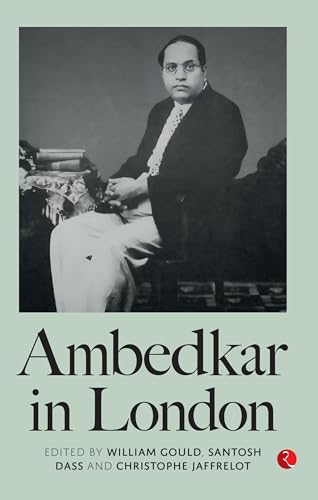
| 954.035092 FAL Feroze : the forgotten Gandhi / | 954.035092 GOP A part apart : the life and thought of B.R. Ambedkar / | 954.035092 GOP-2 A part apart : the life and thought of B.R. Ambedkar / | 954.035092 GOU Ambedkar in London / | 954.035092 NAM The assassination of Mahatma Gandhi : | 954.035092 PAN Why They Killed Gandhi : Unmasking the Ideology and the Conspiracy / | 954.035092 PRA The Dream of Revolution : |
List of illustrations;
Ambedkarite Organisations in Britain since the 1960s;
Foreword Suraj Milind Yengde;
Introduction Santosh Das and William Gould;
PART ONE:
1. Ambedkar the Activist Research Scholar in 1920s London William Gould;
2. A Student in London: Ambedkar at the London School of Economics and Political Science Sue Donnelly and Daniel Payne;
3. Ambedkar as Lawyer: From London to India in the 1920s Steven Gasztowicz KC;
4. Ambedkar, London and the First Round Table Conference Jesús E Cháirez-Garza;
5. Dr Ambedkar in the 1920s: The Transitional Decade Christophe Jaffrelot;
PART TWO:
Part Two: Introduction Santosh Dass and William Gould;
6. The Ambedkarite Movement in Britain Santosh Dass and Arun Kumar;
7. The Ambedkar Museum, London Santosh Dass and Jamie Sullivan;
8. The Campaign to Outlaw Caste Discrimination in Britain Santosh Dass;
9. Ambedkar in London and the African-American Community Kevin Brown;
Conclusion William Gould;
Notes;
Select Bibliography;
Index.
Dr Bhimrao R. Ambedkar (1891–1956) was one of India’s greatest intellectuals and social reformers; his political ideas continue to inspire and mobilise some of the world’s poorest and most socially disadvantaged, in India and the global Indian diaspora. Ambedkar’s thought on labour, legal rights, women’s rights, education, caste, political representation and the economy are international in importance.
This book explores his lesser-known period of London-based study and publication during the early 1920s, presenting that experience as a lens for thinking about Ambedkar’s global intellectual significance. Some of his later canon on caste, and Dalit rights and representation, was rooted in and shaped by his earlier work around the economy, governance, labour, and representation during his time as a law student and as a doctoral candidate at the London School of Economics.
The Indian diaspora in the UK is the country’s single largest national minority. This volume connects Ambedkar’s influence during his lifetime, and his legacy today, to this early phase of his career and intellectual life in London, and its immediate aftermath. It contains new material on the establishment of the city’s Ambedkar Museum, explores Britain’s Ambedkarite movement, and charts the campaign to outlaw caste discrimination in the UK.