

Library Catalogue
| Item type | Current library | Status | Barcode | |
|---|---|---|---|---|
 Open Access Books - Publishers
|
NLS | Available | OABP414 |
Includes bibliographical references and index.
Confronting Colonial Heritage: Introducing Entanglements, Continuities, and Transformations -- Expanding Empire: Curiosity, Power, and Prestige -- Collecting Mania, Racial Science, and Cultural Conversion through Forcible Expeditions -- The Scramble for Cultural Colonial Objects: Other Types of Acquisition -- Collecting Humanity: Commodification, Trophy Hunting, and Bio-colonialism -- Law's Complicity in Cultural Takings and Colonial Violence: Double Standards, Discursive Silencing, and Social Transformation -- Colonial and Post-colonial Continuities in Culture Heritage Protection: Narratives and Counter-narratives -- Acknowledging the Past, Righting the Future: Changing Ethical and Legal Frames -- Beyond to Return or Not to Return: Towards Relational Cultural Justice.
"In 1978, UNESCO Secretary General Amadou-Mahtar M'Bow, compared cultural colonial objects to 'witnesses to history'. Their treatment is one of the most debated questions of our time. Calls for a novel international cultural order go back to decolonization. However, for decades, the issue has been treated as a matter of comity or been reduced to a Shakespearean dilemma: to return or not to return. This book seeks to go beyond these classic dichotomies. It argues that contemporary practices are at a tipping point. It shows that cultural takings were material to the colonial project throughout different periods (early takings, birth of modern nation state, 19th century scramble for objects) and went far beyond looting. It relies on micro histories and object biographies to trace recurring justifications and contestations of takings and returns, and the complicity of anthropology, racial science and professional networks in colonial collecting. It demonstrates the dual role of law and cultural heritage regulation in enabling colonial injustices, and mobilizing resistance thereto. It challenges the argument that takings were acceptable according to the standards of the time. Drawing on the interplay between justice, ethics and human rights, it develops a theory of entanglement to re-think contemporary approaches. It shows that future engagement requires a re-invention of knowledge systems and relations towards objects, including new forms of consent, provenance research, partnership and a re-thinking of the role of museums themselves. It proposes principles of relational cultural justice to confront ongoing historic, legal and economic entanglements and enable normative transformation"-- Provided by publisher.
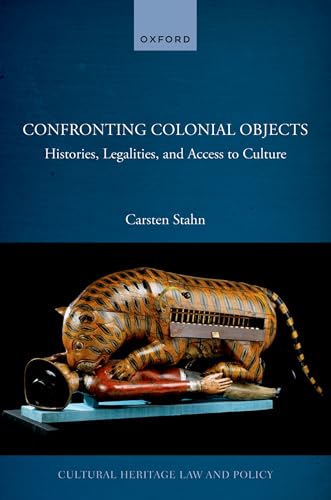
The treatment of cultural colonial objects is one of the most debated questions of our time. Calls for a new international cultural order go back to decolonization. However, for decades, the issue has been treated as a matter of comity or been reduced to a Shakespearean dilemma: to return or not to return. "Confronting colonial objects" seeks to go beyond these classic dichotomies and argues that contemporary practices are at a tipping point. 00The book shows that cultural takings were material to the colonial project throughout different periods and went far beyond looting. It presents micro histories and object biographies to trace recurring justifications and contestations of takings and returns while outlining the complicity of anthropology, racial science, and professional networks that enabled colonial collecting. The book demonstrates the dual role of law and cultural heritage regulation in facilitating colonial injustices and mobilizing resistance thereto. Drawing on the interplay between justice, ethics, and human rights, Stahn develops principles of relational cultural justice. He challenges the argument that takings were acceptable according to the standards of the time and outlines how future engagement requires a re-invention of knowledge systems and relations towards objects, including new forms of consent, provenance research, and partnership, and a re-thinking of the role of museums themselves. Following the life story and transformation of cultural objects, this book provides a fresh perspective on international law and colonial history that appeals to audiences across a variety of disciplines.