
NLSUI OPAC header image
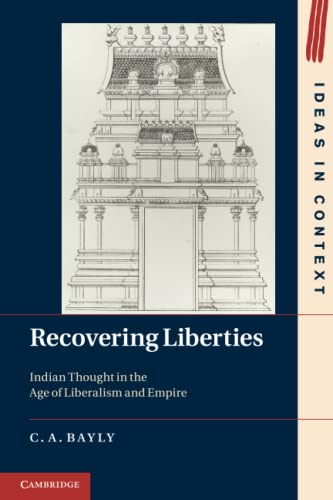
Amazon cover image
Image from Amazon.com

Recovering liberties : Indian thought in the age of liberalism and empire : the Wiles lectures given at the Queen's University of Belfast, 2007 / C.A. Bayly.

By: Publication details: Cambridge, UK ; New York : Cambridge University Press, 2012.Description: x, 383 p. ; 24 cmContent type:
  • text
Media type:
  • unmediated
Carrier type:
  • volume
ISBN:
  • 9781107601475
Subject(s): DDC classification:
  • 320.510954 23
LOC classification:
  • JC574.2.I4 B39 2012
Contents:
Preface -- Introduction: The meanings of liberalism in colonial India -- The social and intellectual contexts of early Indian liberalism, c. 1780-1840 -- The advent of liberalism in India : constitutions, revolutions and juries -- The advent of liberal thought in India and beyond : civil society and the press -- After Rammohan : benign sociology and statistical liberalism -- Living as liberals : Bengal and Bombay c. 1840-1880 -- Thinking as liberals : historicism, race, society, and economy, c. 1840-1880 -- Giants with feet of clay : Asian critics and Victorian sages to 1914 -- Liberals in the Desh : north Indian Hindus and the Muslim dilemma -- "Communitarianism" : Indian liberalism transformed, c.1890- 1916 -- Inter-war : Indian discourse and controversy, 1919-1935 -- Anti-liberalism, 'counter-liberalism' and liberalism's survival, 1920-1950 -- Conclusion : lineages of liberalism in India.
Summary: One of the world's leading historians examines the great Indian liberal tradition, stretching from Rammohan Roy in the 1820s, through Dadabhai Naoroji in the 1880s to G. K. Gokhale in the 1900s. This powerful new study shows how the ideas of constitutional, and later 'communitarian' liberals influenced, but were also rejected by their opponents and successors, including Nehru, Gandhi, Indian socialists, radical democrats and proponents of Hindu nationalism. Equally, Recovering Liberties contributes to the rapidly developing field of global intellectual history, demonstrating that the ideas we associate with major Western thinkers – Mills, Comte, Spencer and Marx – were received and transformed by Indian intellectuals in the light of their own traditions to demand justice, racial equality and political representation. In doing so, Christopher Bayly throws fresh light on the nature and limitations of European political thought and re-examines the origins of Indian democracy. One of the world's leading historians examines the great Indian liberal tradition Provides new insights into the nature of European political thought and reconsiders the origins of Indian democracy A vibrant contribution to the growing fields of global intellectual history and the history of South Asia
Star ratings
    Average rating: 0.0 (0 votes)
Holdings
Item type Current library Shelving location Call number Materials specified Status Notes Barcode
BOOKs NLS General Stacks 320.510954 BAY (Browse shelf(Opens below)) PB Available Recommended by Mr. Kunal Ambasta 40321

Includes bibliographical references (p. 360-379) and index.

Preface -- Introduction: The meanings of liberalism in colonial India -- The social and intellectual contexts of early Indian liberalism, c. 1780-1840 -- The advent of liberalism in India : constitutions, revolutions and juries -- The advent of liberal thought in India and beyond : civil society and the press -- After Rammohan : benign sociology and statistical liberalism -- Living as liberals : Bengal and Bombay c. 1840-1880 -- Thinking as liberals : historicism, race, society, and economy, c. 1840-1880 -- Giants with feet of clay : Asian critics and Victorian sages to 1914 -- Liberals in the Desh : north Indian Hindus and the Muslim dilemma -- "Communitarianism" : Indian liberalism transformed, c.1890- 1916 -- Inter-war : Indian discourse and controversy, 1919-1935 -- Anti-liberalism, 'counter-liberalism' and liberalism's survival, 1920-1950 -- Conclusion : lineages of liberalism in India.

One of the world's leading historians examines the great Indian liberal tradition, stretching from Rammohan Roy in the 1820s, through Dadabhai Naoroji in the 1880s to G. K. Gokhale in the 1900s. This powerful new study shows how the ideas of constitutional, and later 'communitarian' liberals influenced, but were also rejected by their opponents and successors, including Nehru, Gandhi, Indian socialists, radical democrats and proponents of Hindu nationalism. Equally, Recovering Liberties contributes to the rapidly developing field of global intellectual history, demonstrating that the ideas we associate with major Western thinkers – Mills, Comte, Spencer and Marx – were received and transformed by Indian intellectuals in the light of their own traditions to demand justice, racial equality and political representation. In doing so, Christopher Bayly throws fresh light on the nature and limitations of European political thought and re-examines the origins of Indian democracy.
One of the world's leading historians examines the great Indian liberal tradition
Provides new insights into the nature of European political thought and reconsiders the origins of Indian democracy
A vibrant contribution to the growing fields of global intellectual history and the history of South Asia