

Library Catalogue
| Item type | Current library | Shelving location | Call number | Materials specified | Status | Notes | Barcode | |
|---|---|---|---|---|---|---|---|---|
 BOOKs
BOOKs
|
NLS | General Stacks | 346.0482 MYS-2 (Browse shelf(Opens below)) | HB | Available | Gift from the author | 40851 | |
|
BOOKs
|
NLS | General Stacks | 346.0482 MYS (Browse shelf(Opens below)) | HB | Not For Loan | Recommended by Dr. Betsy Rajasingh | 40475 |

|

|

|

|
|

|

|
||
| 346.0482 HUG The future of copyright in a digital environment : Proceedings of the royal academy colloquium / | 346.0482 JAC The parody exception in copyright law / | 346.0482 LAI The copyright protection of computer software in the United Kingdom / | 346.0482 MYS Copyright as personal property / | 346.0482 MYS-2 Copyright as personal property / | 346.0482 NAN Understanding integrative intelligence : embodied in S Model / | 346.0482 NAR Law of copyright and industrial designs / |
1: Setting the Stage
2: Thing-Relatedness in Copyright
3: Acquisition of Copyright
4: Exclusionary Rights, Exclusive Powers, and Privileges in Copyright
5: Copyright Enforcement and Remedies
6: Defences and Limits on Uses
7: Derivative Interests in Copyright;
Final Remarks
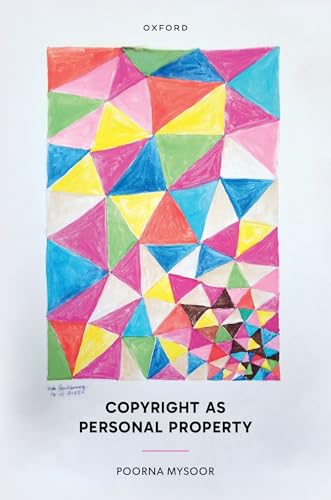
Copyright statutes in many jurisdictions clearly state that copyright is a property right. However, it's not always clear exactly how. Some see it as no more than a statutory right, while others think of it as a chose in action, like debts or shares. Copyright as Personal Property demonstrates why it is incorrect to conceptualize copyright as a chose in action and argues that, despite being an intangible asset, copyright is more analogous to land and chattels.
This book aims to achieve two main objectives. The first is to demonstrate much against popular belief that the analogies with land and chattels help contain the scope of copyright within normatively justifiable limits. Starting with the "thing-relatedness" of copyright, the monograph draws parallels with the acquisition of copyright, the nature of exclusionary rights, exclusive powers and privileges, their enforcement, and derivative interests. It employs concepts of property theory, such as numerus clausus, to provide the necessary benchmark to guide the boundaries of copyright. The second objective is to challenge the rigid and binary classification of property rights into choses in possession and choses in action. By addressing an important evolutionary gap in the conceptualization of property rights, this work lays the groundwork for a more sophisticated taxonomy, viewing property rights as existing on a spectrum. It goes on to provide the metrics to calibrate this spectrum, ensuring the incremental and orderly development of property rights.
Original and thought-provoking, the analogy this book develops with land and chattels shows how the unjustifiable expansion of copyright can be curbed and offers a more sophisticated classification of property rights than that based simply on tangibility.