

NLSUI OPAC header image
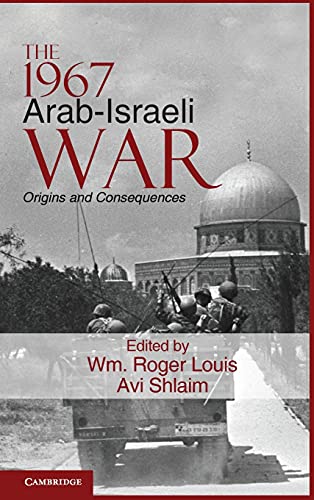
Amazon cover image
Image from Amazon.com

The 1967 Arab-Israeli war : origins and consequences / edited by Wm. Roger Louis and Avi Shlaim.

Contributor(s): Series: Cambridge Middle East studies ; 36Publication details: Cambridge ; New York : Cambridge University Press, 2012.Description: xvii, 325 p. : maps ; 23 cmISBN:
  • 9781107002364 (hardback)
  • 9780521174794 (paperback)
Subject(s): DDC classification:
  • 956.04/6 23
LOC classification:
  • DS127 .A55 2012
Other classification:
  • HIS026000
Contents:
Table of Contents: Introduction 1. Israel: poor little Samson Avi Shlaim 2. Egypt: dangerous illusions Laura M. James 3. Syria: playing with fire David Lesch 4. Jordan: walking the tight rope Avi Shlaim 5. The Palestinian national movement Wendy Pearlman 6. The Yemen war and Egypt's war preparedness in June 1967 Eugene Rogan and Tewfik Aclimandos 7. The United States and the 1967 war Charles D. Smith 8. The Soviet Union: the roots of war and a reassessment of historiography Rami Ginat 9. Britain: the ghost of Suez and resolution 242 Wm. Roger Louis 10. France and the June 1967 war Jean-Pierre Filiu 11. The 1967 war and the demise of Arab nationalism: chronicle of a death foretold Rashid Khalidi 12. The transformation of Arab politics: disentangling myth from reality Fawaz A. Gerges.
Summary: "The June 1967 war was a watershed in the history of the modern Middle East. In six days, the Israelis defeated the Arab armies of Egypt, Syria, and Jordan and seized large portions of territory including the West Bank, East Jerusalem, the Gaza Strip, the Sinai Peninsula, and the Golan Heights. With the hindsight of four decades and access to recently declassified documents, two veteran scholars of the Middle East bring together some of the most knowledgeable experts in their fields to reassess the origins of the war and its regional reverberations. Each chapter takes a different perspective from the vantage point of a different participant, those that actually took part in the war, and also the world powers, the United States, Soviet Union, Britain, and France, that played important roles behind the scenes. Their conclusions make for sober reading. At the heart of the story was the incompetence of the Egyptian high command under the leadership of Nasser and the rivalry between various Arab players who were deeply suspicious of each other, motives. Israel, on the other side, gained a resounding victory for which, despite previous assessments to the contrary, there was no master plan"-- Provided by publisher.
Star ratings
    Average rating: 0.0 (0 votes)
Holdings
Item type Current library Shelving location Call number Status Barcode
BOOKs NLS Library Compactors 956.04 LOU (Browse shelf(Opens below)) Available 27755

Includes bibliographical references and index.

Table of Contents:
Introduction
1. Israel: poor little Samson Avi Shlaim
2. Egypt: dangerous illusions Laura M. James
3. Syria: playing with fire David Lesch
4. Jordan: walking the tight rope Avi Shlaim
5. The Palestinian national movement Wendy Pearlman
6. The Yemen war and Egypt's war preparedness in June 1967 Eugene Rogan and Tewfik Aclimandos
7. The United States and the 1967 war Charles D. Smith
8. The Soviet Union: the roots of war and a reassessment of historiography Rami Ginat
9. Britain: the ghost of Suez and resolution 242 Wm. Roger Louis
10. France and the June 1967 war Jean-Pierre Filiu
11. The 1967 war and the demise of Arab nationalism: chronicle of a death foretold Rashid Khalidi
12. The transformation of Arab politics: disentangling myth from reality Fawaz A. Gerges.

"The June 1967 war was a watershed in the history of the modern Middle East. In six days, the Israelis defeated the Arab armies of Egypt, Syria, and Jordan and seized large portions of territory including the West Bank, East Jerusalem, the Gaza Strip, the Sinai Peninsula, and the Golan Heights. With the hindsight of four decades and access to recently declassified documents, two veteran scholars of the Middle East bring together some of the most knowledgeable experts in their fields to reassess the origins of the war and its regional reverberations. Each chapter takes a different perspective from the vantage point of a different participant, those that actually took part in the war, and also the world powers, the United States, Soviet Union, Britain, and France, that played important roles behind the scenes. Their conclusions make for sober reading. At the heart of the story was the incompetence of the Egyptian high command under the leadership of Nasser and the rivalry between various Arab players who were deeply suspicious of each other, motives. Israel, on the other side, gained a resounding victory for which, despite previous assessments to the contrary, there was no master plan"-- Provided by publisher.