

Library Catalogue
| Item type | Current library | Shelving location | Call number | Materials specified | Status | Notes | Barcode | |
|---|---|---|---|---|---|---|---|---|
 BOOKs
BOOKs
|
NLS | REFERENCE SECTION | 340.115 CUM (Browse shelf(Opens below)) | HB | Not For Loan | Recommended by Dr. Sidharth Chauhan | 40837 |
Includes bibliographical references and index.
PART I INTRODUCTION:
1 Toward a sociology of legal ethics by Tamara Butter, Scott Cummings, Sergio Anzola and Ole Hammerslev -
PART II THEORIES AND APPROACHES:
2 Legal ethics and the moral economy of legal practice by Julian Webb -
3 Biography, legal ethics and the climate crisis by Susan Bartie -
4 Understanding the nuances of big law ethics: the specialty-specific approach by Trevor Clark -
5 Ethics of feminist lawyering in Turkey by Seda Kalem -
6 Empirical legal ethics: learning from disciplinary cases by Richard L. Abel
PART III INSTITUTIONALIZATION OF LEGAL ETHICS FROM ABOVE:
7 Integrating empirical perspectives into legal ethics education by Ann Southworth -
8 “Discipline and punish?” The role of the abuse of the right of individual application for building ethical standards for lawyers by Ezgi Özlü -
9 Common ethical standards for defenders before the Court of Justice of the European Union by Stefania Adriana Bevilacqua -
10 The institutionalization of legal ethics in South Africa: the double movement of profession and education by Jonathan Klaaren
PART IV LEGAL ETHICS FROM BELOW:
11 Disciplinary power: ‘runners’, cause lawyering and the demonization of Phil Shiner by Ka Lok Yip -
12 The professional ethics of Christian lawyers in Australia by Katie Murray -
13 Colombia’s legal defense before the Inter-American Court of Human Rights: who is the client and who is the lawyer? By Sergio Anzola
14 Hybrid agency in a boundary-blurring space: the development of an (inter) national legal market in Cabo Verde and Mozambique by Susana Santos
15 Legal ethics, social justice and the transformative role of Japanese lawyers by Adrienne Sala -
16 Professional ethical dilemmas of government lawyers by Nienke Doornbos and Arnt Mein
17 Dual or duelling identities: developing an ethical professional identity as lawyer and director by Karina Murray -
PART V MEETING GLOBAL CHALLENGES:
18 “Who’s the fairest of them all?” The construction of ethical hierarchy in the legal profession by Lynn Mather and Leslie C. Levin
19 Prosecutors’ independence by Bruce A. Green and Rebecca Roiphe
20 Lawfare, the rule of law and lawyers’ ethics by Christopher Whelan
21 The role of lawyers in mature democracies when the rule of law is under attack by Eli Wald -
22 The legal profession and climate change by Jessica A. Roth -
23 The professional ecology of lawyers, legal ethics, and democratic backsliding in Brazil by
Maria da Gloria Bonelli -
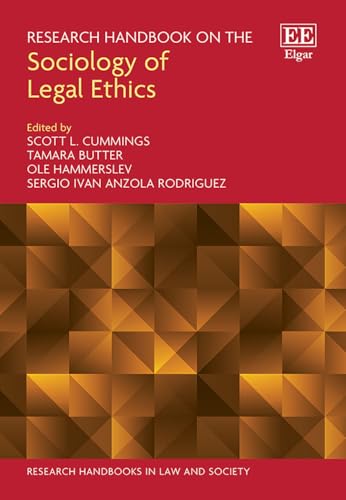
Situating legal ethics in relation to classical sociology of law themes, this astute Research Handbook investigates ethics as a contested set of professional rules designed to protect clients and serve the public, revealing how they operate in action to shape lawyers’ relation to state and market power.
Expert authors discuss how legal ethics can reflect and legitimate structural inequalities in the legal profession and wider society, exploring their institutionalization within specific social and political contexts. They assess the consequences of ethics enforcement on stratification and access to justice, as well as the influence of ethics in larger conflicts over democracy, authoritarianism, and the rule of law. The Research Handbook presents a broad range of global perspectives through empirical studies covering the institutionalization of legal ethics in South Africa, feminist lawyering in Turkey, the ethics of Christian lawyers in Australia, and the development of professional standards in European courts, among others. Based on this innovative work, the book provides a framework for understanding the sociology of legal ethics that distinguishes it from other research in the field by placing the social role of ethical rules and their enforcement at the centre of study.
Scholars and students of law and society, legal ethics, sociology and sociological theory will greatly benefit from this compelling Research Handbook. Providing empirical insights into how lawyers understand and practice ethics in their daily work lives, and how ethics can serve to check abuses of government power, it is also an essential resource for practitioners and policymakers.