

Library Catalogue
| Item type | Current library | Shelving location | Call number | Materials specified | Status | Notes | Barcode | |
|---|---|---|---|---|---|---|---|---|
 BOOKs
BOOKs
|
NLS | REFERENCE SECTION | 342.06 LIN (Browse shelf(Opens below)) | HB | Not For Loan | Recommended by Prof. Dr. Sudhir Krishnaswamy | 40857 |
Foreword vii -
Introduction 1 -
PART I PLURAL LEGACIES OF DECOLONIZATION IN ADMINISTRATIVE LAW:
1 Transnational regulation, TWAIL, and the rise of the Global South by Victor V. Ramraj and Ngozi S. Nwoko -
2 Vernacularizing administrative law in Commonwealth African jurisdictions by Geo Quinot -
3 The hybridization of administrative law: exploring the Caribbean Court of Justices’ ‘chiastic’ jurisprudence by Justice Peter Jamadar -
4 The diffusion of the public trust doctrine in South Asia: environmental constitutionalism or beyond? By Dinesha Samararatne and Tavini Nanayakkara -
PART II ADMINISTRATIVE LAW AND CONSTITUTIONAL POLITICS:
5 When the administrative state encounters the Constitution by Athanasios (Akis) Psygkas -
6 Democratic legitimacy of regulation-making in the UK and Australia: the impact of semi-parliamentarism by Andrew Edgar -
7 Engaging democracy: A procedural route to democratic accountability through Indigenous rights in Canada and economic and social rights in South Africa by Richard Stacey -
8 Politics by Other Means: Judicial Review of Administrative Action in France and the USA by Cyrille Beaufils and Noah A. Rosenblum -
9 The major questions doctrines: a case study on the domestic ‘possibilities’ of comparative administrative law by Oren Tamir -
PART III ACCOUNTABILITY AND THE EVOLVING STRUCTURES AND FUNCTIONING OF ADMINISTRATIVE GOVERNANCE:
10 Administrative justice and outsourced service-delivery by Janina Boughey
11 Reorganizing review of administrative adjudication in the welfare state by Andrew Hammond
12 Towards a process-oriented review of decisions under conditions of scientific uncertainty: case studies of Japan and China by Yun Ma and Narufumi Kadomatsu -
13 Exploring the uncharted world of audit institutions by Eugenio García-Huidobro -
14 Ombuds and maladministration: the case of Indonesia and the Netherlands by Susi Dwi Harijanti and Richo Andi Wibowo -
15 The use of comparative law by the French Conseil d’Etat: a testimony of the 15 years of its Comparative Law Unit by Eduardo Jordão -
PART IV ADMINISTRATIVE GOVERNANCE BEYOND THE STATE, REVISITED:
16 International cconomic law and comparative administrative law by Georgios Dimitropoulos
17 The many faces of ‘good administration’ in European integration: the European Union and Council of Europe in comparative perspective by Yseult Marique and Ulrich Stelkens -
18 Conditional spending as an instrument of Government by Cristina Fasone and Marta Simoncini -
19 Funding as a tool in administrative law: EU structural funds as a case study by Leticia Díez Sánchez, Mariolina EliantonioEmilia Korkea-aho -
20 Emergency governance based on Art. 122 TFEU: the end of EU Constitutionalism? By Matthias Ruffert.
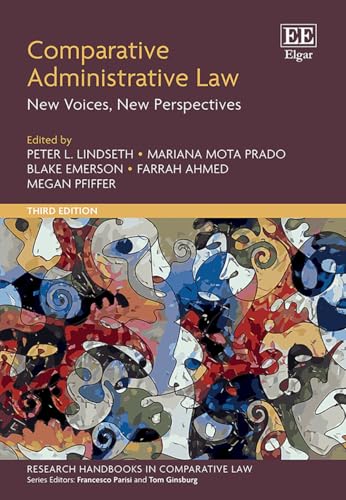
This thoroughly revised third edition of Comparative Administrative Law builds on the legacy of the first two editions, providing a redefined and reinvigorated analysis of pressing issues through original chapters, a renewed group of contributors and a broader geographic scope, with particular emphasis on the Global South.
Leading scholars offer novel perspectives, investigating the intersecting differences between common law and civil law, including cultural traditions and political systems. Most chapters provide comparative analyses of administrative law across at least two legal orders, while others explore comparative law themes and issues within a single jurisdiction. The result of this combination is a rich and detailed description of legal doctrines, institutional arrangements and practices across multiple jurisdictions. Furthermore, key topics such as the plural legacies of decolonization in administrative law, the relationship of administrative law to constitutional politics, and the challenge of legality in administrative governance beyond the state are also covered.
Scholars and students of comparative public law, international economic law, as well as law and development will benefit from this book’s insights. It is also a valuable resource for judges, lawyers, policymakers, regional integration bodies, and NGOs interested in comparative and legal perspectives on regulation, governance, and public bureaucracies.