

NLSUI OPAC header image
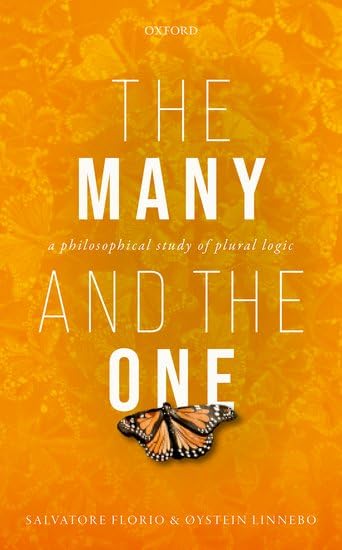
Amazon cover image
Image from Amazon.com

The many and the one : a philosophical study of plural logic / Salvatore Florio and Øystein Linnebo.

By: Contributor(s): Publisher: Oxford, United Kingdom : Oxford University Press, 2021Edition: First editionDescription: xii, 314 pages ; 23 cmContent type:
  • text
Media type:
  • unmediated
Carrier type:
  • volume
ISBN:
  • 9780198791522
Subject(s): Online resources: Summary: "Plural logic has become a well-established subject, especially in philosophical logic. This book explores its broader significance for philosophy, logic, and linguistics. What can plural logic do for us? Are the bold claims made on its behalf correct? After introducing plural logic and its main applications, the book provides a systematic analysis of the relation between this logic and other theoretical frameworks such as set theory, mereology, higher-order logic, and modal logic. The applications of plural logic rely on two assumptions, namely that this logic is ontologically innocent and has great expressive power. These assumptions are shown to be problematic. The result is a more nuanced picture of plural logic's applications than has been given so far. Questions about the correct logic of plurals play a central role in the last part of the book, where traditional plural logic is rejected in favor of a "critical" alternative. The most striking feature of this alternative is that there is no universal plurality. This leads to a novel approach to the relation between the many and the one. In particular, critical plural logic paves the way for an account of sets capable of solving the set-theoretic paradoxes"-- Provided by publisher.
Star ratings
    Average rating: 0.0 (0 votes)
Holdings
Item type Current library Status Barcode
Open Access Books - Publishers NLS Available OABP323

Minimal Level Cataloging Plus. DLC

Includes bibliographical references (pages 297-306) and index.

"Plural logic has become a well-established subject, especially in philosophical logic. This book explores its broader significance for philosophy, logic, and linguistics. What can plural logic do for us? Are the bold claims made on its behalf correct? After introducing plural logic and its main applications, the book provides a systematic analysis of the relation between this logic and other theoretical frameworks such as set theory, mereology, higher-order logic, and modal logic. The applications of plural logic rely on two assumptions, namely that this logic is ontologically innocent and has great expressive power. These assumptions are shown to be problematic. The result is a more nuanced picture of plural logic's applications than has been given so far. Questions about the correct logic of plurals play a central role in the last part of the book, where traditional plural logic is rejected in favor of a "critical" alternative. The most striking feature of this alternative is that there is no universal plurality. This leads to a novel approach to the relation between the many and the one. In particular, critical plural logic paves the way for an account of sets capable of solving the set-theoretic paradoxes"-- Provided by publisher.