

Library Catalogue
| Item type | Current library | Shelving location | Call number | Materials specified | Status | Barcode | |
|---|---|---|---|---|---|---|---|
 BOOKs
BOOKs
|
NLS | REFERENCE SECTION | 320.51 SAJ (Browse shelf(Opens below)) | HB | Available | 38578 |
Table of Contents
Part 1: Theoretical perspectives
1. The antiliberal ideaStephen Holmes;
2. The history of illiberalism Helena Rosenblatt;
3. Illiberalism and opposition to the Enlightenment Graeme Garrard;
4. Contemporary Christian criticism of liberalism Gladden Pappin;
5. Left and New Left critiques of liberalism Michael C. Behrent;
6. Conservativism as illiberalism Andy Hamilton;
7. Asian values, Confucianism, and illiberal constitutions Wen-Chen Chang;
8. A theory of illiberal democracy Ulrich Wagrandl;
Part 2: Forms of illiberal government
9. Illiberal regime types Nenad Dimitrijevic;
10. Hybrid regimes Leonardo Morlino;
11. Theocracy Ran Hirschl;
12. Authoritarian structures and trends in consolidated democracies Helena Alviar García and Günter Frankenberg;
Part 3: Ideas and Forces Fuelling Illiberalism
13. The ideational core of democratic illiberalism Ruzha Smilova;
14. The people in ancient times and the rise of ’popularism’ Claudia Moatti and Christel Müller
15. The illiberal potential of the people Zoran Oklopcic;
16. Identity, narratives and nationalism Mabel Berezin;
17. Illiberalism and national sovereignty Neil Walker;
18. Populism and illiberalism Paul Blokker;
19. Illiberalism and the multicultural backlash Rita Chin;
20. Illiberal democracy and the politicization of immigration Leila Hadj Abdou;
21. Gender and illiberalism Andrea Pető;
22. Illiberalism and Islam Aziz Z. Huq;
Part 4: Illiberal practices
23. Illiberal practices Marlies Glasius;
24. Surveillance in the illiberal state Steven Feldstein;
25. Media control and post-truth communication Eileen Culloty and Jane Suiter;
26. Illiberal practices and the management of protest and dissent Michael Hamilton;
27. The body of the nation: Illiberalism and gender Susanna Mancini and Nausica Palazzo;
Part 5: Government and governance
28. The myth of the illiberal democratic constitution David Landau;
29. Constitutional practices in times ’after liberty’ Renáta Uitz;
30. Parliaments in an Era of Illiberal Executives David Schneiderman;
31. Political parties, elections, and pernicious polarization in the rise of illiberalism Jennifer McCoy and Murat Somer;
32. The plebiscite in modern democracy Samuel Issacharoff and J. Colin Bradley;
33. Illiberal constitutionalism and the judiciary Mirosław Wyrzykowski and Michal Ziółkowski;
34. Illiberalism and the rule of law Martin Krygier;
35. Emergencies and illiberalism Alan Greene;
36. Illiberalism of military regimes Nam Kyu Kim;
37. Towards a post-liberal approach to political ordering Philipp Lottholz;
Part 6: Economy, society and psychology
38. The social requisites of illiberalism Gábor Scheiring;
39. The psychological construction of the illiberal subject Frank Furedi;
40. The psychology of authoritarianism and support for illiberal policies and parties Stanley Feldman, Vittorio Mérola and Justin Dollman;
41. Illiberal politics and group-based needs for recognition and dominance Bjarki Gronfeldt, Aleksandra Cichocka, Marta Marchlewska, and Aleksandra Cislak;
42. Illiberal economic policies László Csaba;
43. Economic Consequences of Illiberalism in Eastern Europe Paula Ganga;
Part 7: Regional and national variations
44. Asia’s illiberal governments Tom Ginsburg;
45. Cultural sources and institutional practice of authoritarianism in China Hongyi Lai;
46. The intertwining of liberalism and illiberalism in India Arun K. Thiruvengadam;
47. Indonesia’s ‘third-wave’ democratic model? Abdil Mughis Mudhoffir and Vedi R. Hadiz;
48. Latin America breathing: Liberalism and illiberalism, once and again Roberto Gargarella;
49. From antiestablishmentarianism to Bolsonarism in Brazil Rafael Mafei, Thomas Bustamante, Emilio Peluso Neder Meyer;
50. The Balkans Dimitri A. Sotiropoulos;
51. Illiberalism in East Central Europe Gábor Halmai;
52. The illiberal challenge in the European Union Yves Bertoncini and Dominique Reynié;
53. Turkey as a model of Muslim authoritarianism? Halil Ibrahim Yenigun;
Part 8: Global perspectives
54. Illiberalism and human rights Marie-Luisa Frick;
55. Free trade in peril Michael Lee;
56. International sources of democratic backsliding Anna Meyerrose;
The crisis of liberal world order Elias Götz;
Part 9: Sources of resistance
58. The weaknesses of illiberal regimes Benjamín García-Holgado and Aníbal Pérez-Liñán;
59. Civil society, crisis exposure and resistance strategies Nicole Bolleyer
60. Politics after the normalization of shamelessness Benjamin Arditi;
Part 10: Themes for future research
61. A compass for future research András Sajó and Renáta Uitz;
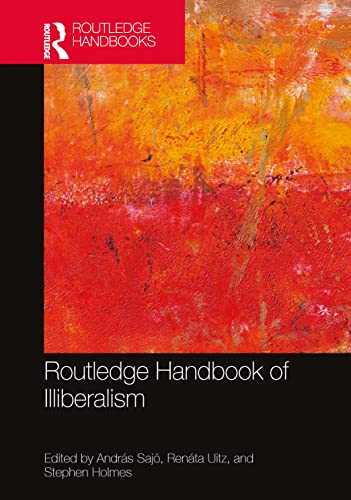
"This volume is the first authoritative reference work solely dedicated to the various components of illiberalism. Illiberalism is most often discussed in political and constitutional terms, yet illiberalism is rooted in society and cannot be limited to only political or legal treatment. Illiberal trends are present all over the world and are not fixed to one era. This Handbook comprises over sixty individual chapters, each dedicated to different aspects of the same phenomenon, presented through the lens of different disciplines and authored by an internationally recognized expert in the field. It charts all representative countries and regions where illiberalism is present and deals with the most important historical antecedents. The Routledge Handbook of Iliberalism will form an important component of any library's holding and will be of benefit as an academic reference, as well as being of practical value to anyone who wishes to gain a clear understanding of the concepts required to explain this conundrum"-- Provided by publisher.